
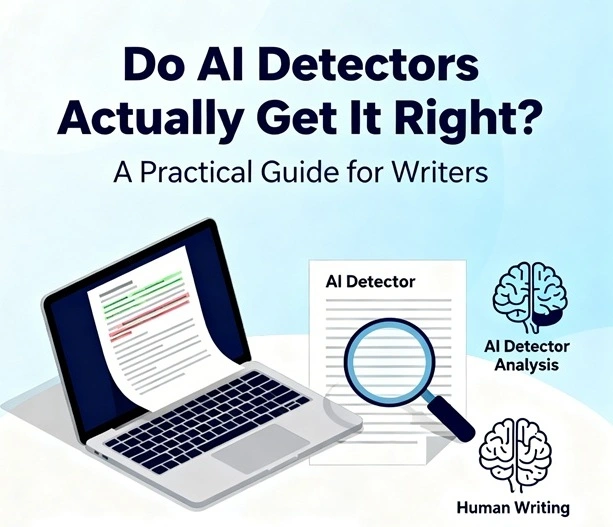
AI detectors read text like a system, not a reader. They do not interpret emotion or intent. They scan structure, flow, grammar habits, readability, phrase repetition, and the probability that the text is machine-made. A strong AI detector splits content into measurable signals.
These are the core signals most tools check:
- Sentence length distribution
- Punctuation patterns
- Predictability of text
- Repeated phrase chains (N-grams)
- Complexity of grammar structures
- Sudden topic or logic shifts
- Writing style consistency
A good AI detector does not scan all signals at once. Each signal is checked separately to build a probability score.
The Math Behind Detection Scores:
Two technical ideas control most verdicts: perplexity and burstiness.
Perplexity measures how predictable a sentence is. Human writing is harder to predict. AI text is often easier because it follows a steady structure. If the text is too predictable, an AI detector increases the probability that the content came from a machine.
Burstiness checks how much sentence lengths and structure jump. Humans mix short and long sentences. We change rhythm often. AI text can be too steady. That steady rhythm can become a footprint for the AI detector.
How N-grams Influence Detection:
N-grams are small phrase chains, like 2–5 tokens long. These chains are checked in sequence. Humans rarely repeat tiny chains in the same distribution. AI content can repeat them more often. This is why online writers sometimes use tools like a summarizer and a paraphrasing tool to break repetitive phrasing before running AI detectors.
Common AI Detector Limitations:
Even the best AI detector can fail when:
- Text is extremely short
- Language is too simple or rigid by nature
- The topic forces formal phrasing
- The draft uses a templated structure
- The model was trained on limited writing styles
- The classifier has not learned new AI writing habits yet
These limits matter. They impact trust. Writers must know them before using these tools as a final verdict system.
AI Detector vs Traditional Text Tools
Traditional plagiarism tools match text with known sources. AI detectors do not match sources. They check the writing style itself. That is the key difference.
A grammar checker only fixes errors. A summarizer only cuts text length. A paraphrasing tool only changes phrasing. But an AI detector judges the whole text and returns a probability score. The AI detector verdict is based on patterns.
Google accepts AI content if it has value. It does not penalize origin. It penalizes low-value text. This is important for SEO writers who run AI detectors before publishing. AI detectors can guide edits, but they do not decide ranking.
Risks When Using Paraphrasing Tools
Common risks include:
- Changing facts by mistake
- Rewriting sentences into odd grammar
- Making sentences too short or too uniform
- Increasing readability to a level that is unnatural
- Repeating new phrase chains too often
- Breaking original intent
Smart Habits for Using a Paraphrasing Tool
- Rewrite small parts, not the full draft
- Check the meaning after each rewrite
- Mix sentence sizes after using the paraphrasing tool
- Add manual edits to avoid templated phrasing
- Do not rewrite lines that do not need fixing
- Run the AI detector only after manual review
Summarizers and How They Support AI Detection
A summarizer pulls the main idea from a long text. It drops filler lines. It makes the content smaller for faster scanning. This helps writers run AI detectors on crisp drafts rather than on long, noisy ones.
Smart Steps to Use a Summarizer
- Paste the long draft into the summarizer
- Read the summary carefully
- Add human edits back
- Check facts again
- Run the AI detector last
Grammar Checkers: Helpful, But Not a Final Fix
A grammar checker corrects spelling, tense issues, spacing errors, and missing punctuation. It helps readability. But it must not over-polish. AI detectors can see overly polished text as templated. That templated polish can increase flags.
Safe Grammar Checker Habits
- Fix basic errors only
- Review every suggestion before applying
- Do not rewrite full sentences using the grammar checker
- Add sentence length variation after fixes
Accuracy Rates, Claims, and Real-World Results
AI detector accuracy claims often come from lab tests. Tools claim 99% accuracy or extremely low false positives. But real content is messy. Drafts vary. Topics vary. Tools vary. The same AI detector can give different scores for two human-written drafts if the structure or phrasing is too uniform.
Study-Backed Accuracy Gaps
A peer-reviewed study showed detection rates between 19.8% and 98.4% based on tool and text type. That is a big swing. This means AI detectors are not a single source of truth.
Why Human Writing Gets Flagged
Human writing gets flagged when:
- Sentences are too short or all of similar size
- Grammar is overly corrected by a grammar checker
- Paraphrasing tool creates new repetitive phrasing
- The topic forces rigid language
- There are no natural logic jumps
- Keywords are stacked too close together
- The classifier model is outdated
Practical Tips for Writers to Reduce False Flags
- Keep sentence starters different
- Avoid stacking keywords in one line
- Mix short and long sentences
- Add small human quirks, but not too many
- Check facts after using the summarizer
- Review the paraphrasing tool edits carefully
- Use the grammar checker for basics only
- Run AI detector at the end, not the start
Conclusion
AI detectors help scan patterns and guide edits. They work best when the text shows steady AI phrasing habits, uniform sentence sizes, or repeated phrase chains. Writers often combine summarizer, grammar checker, and paraphrasing tools before running an AI detector to clean drafts and reduce noise.
But AI detectors are not always correct. Accuracy rates swing widely based on topic, tool, sentence rhythm, and training data quality. Google has clearly said it ranks content by value, not origin. That means the AI detector score is a signal for editing, not a signal for ranking.
The best content check still ends with a human writer reading the final draft, fixing flagged lines, and checking facts one last time.

I’m Bipasha Zaman, a dedicated Content Writer with a passion for crafting clear, engaging, and impactful content. I specialize in creating blogs, and articles, that inform, inspire, and connect with readers. My goal is to deliver content that adds value, and ells stories effectively. I have worked across diverse niches, consistently delivering high-quality content that builds brand authority and strengthens online presence.